
U.S. Office Market Part 2: A Supply Drought and the Rise of Adaptive Reuse
A Supply Drought and the Rise of Adaptive Reuse
While the U.S. office market grapples with high vacancy rates, a significant stabilizing force is emerging from the supply side: a dramatic reduction in new construction coupled with a surge in adaptive reuse projects. This dual trend is actively reshaping urban landscapes, addressing the housing crisis, and paving the way for a more sustainable future.
As traditional office demand lags, adaptive reuse is surging. The pipeline for office-to-apartment projects is set to reach a record-breaking milestone of nearly 71,000 units in 2025, a significant leap from 55,300 in 2024. These conversions now make up about 42% of all future adaptive-reuse projects, highlighting a powerful shift in how developers are addressing both office obsolescence and the national housing shortage.
Lorem ipsum dolor sit amet, consectetur adipiscing elit. Ut elit tellus, luctus nec ullamcorper mattis, pulvinar dapibus leo.
Introduction:
While the U.S. office market grapples with high vacancy rates, a significant stabilizing force is emerging from the supply side: a dramatic reduction in new construction coupled with a surge in adaptive reuse projects. This dual trend is actively reshaping urban landscapes, addressing the housing crisis, and paving the way for a more sustainable future.
As traditional office demand lags, adaptive reuse is surging. The pipeline for office-to-apartment projects is set to reach a record-breaking milestone of nearly 71,000 units in 2025, a significant leap from 55,300 in 2024. These conversions now make up about 42% of all future adaptive-reuse projects, highlighting a powerful shift in how developers are addressing both office obsolescence and the national housing shortage.
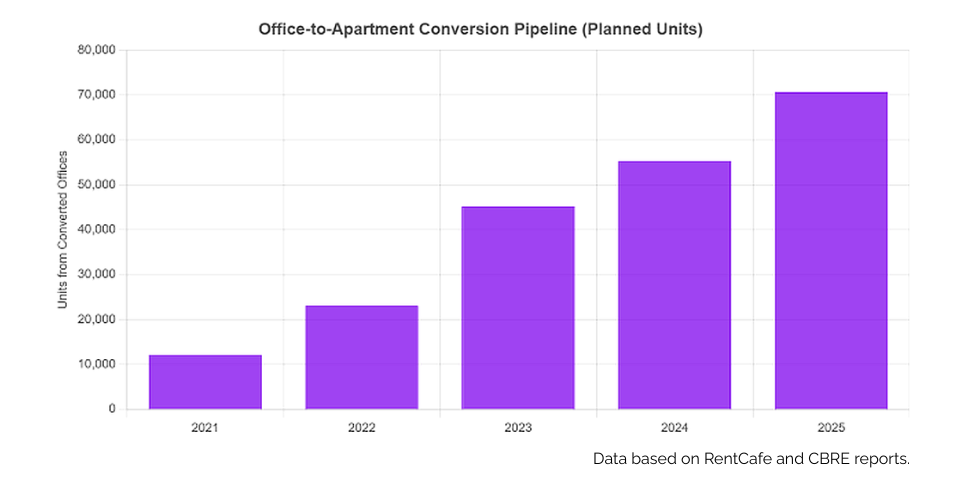
The trend is strongest in high-distress markets with chronic vacancies, where local governments are providing incentives such as tax abatements and zoning reforms to encourage revitalization. The largest pipelines for these projects are concentrated in major metropolitan areas, with significant activity in the Northeast, Midwest, and West.
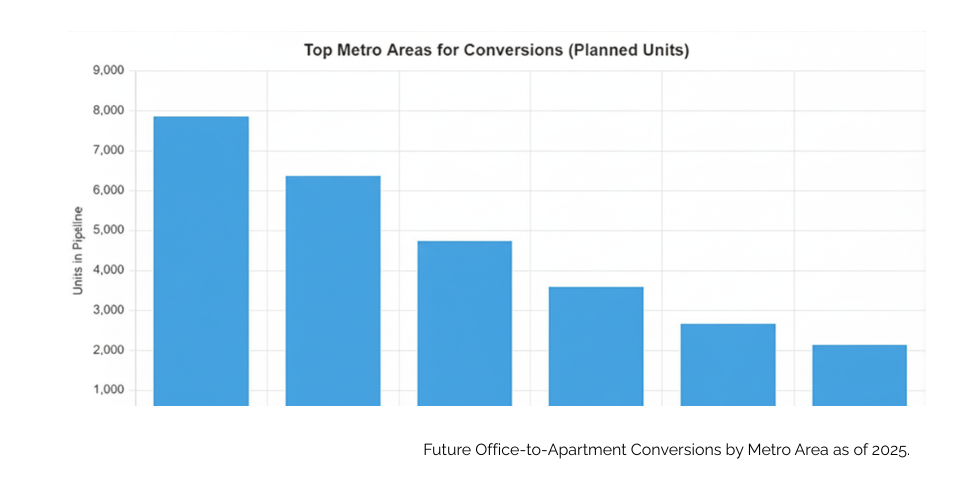
Four metros in particular have more than doubled their conversion pipelines from last year: Charlotte, NC (+107%), Omaha, NE (+141%), Jacksonville, FL (+150%), and Boston, MA (+160%). This highlights the growing national adoption of adaptive reuse as a core strategy.
An Evolving Definition of “Obsolete”
The profile of buildings targeted for conversion is also changing. RentCafe notes that offices targeted for conversion average just 72 years old, 20 years newer than prior conversions. This indicates that even newer-vintage buildings are now being considered “obsolete” due to
functional, not just physical, depreciation. This trend underscores the “brown discount” on properties that lack modern amenities, efficient floor plates, and wellness features, making them prime candidates for a new life.
Strategic Implications
The confluence of a dwindling construction pipeline and an accelerating conversion trend has significant implications for the market. It means that for the first time in over a decade, more office space is being removed through conversion or demolition than is being added through new construction. This net reduction in supply is a crucial step towards rebalancing the market and should help alleviate some of the upward pressure on the national vacancy rate in
the coming quarters.
Data Sources
- RentCafe Adaptive Reuse Report
- CBRE Research
- CommercialEdge National Office Report
- The MortgagePoint
- NAIOP Adaptive Reuse Report